#include <ILogger.hpp>
Public Types | |
| enum class | Severity { TRACE , DEBUG , INFO , WARN , ERR , FATAL } |
Public Member Functions | |
| virtual | ~ILogger ()=default |
| template<typename... Args> | |
| void | trace (fmt::format_string< Args... > log, Args &&... args) |
| template<typename... Args> | |
| void | debug (fmt::format_string< Args... > log, Args &&... args) |
| template<typename... Args> | |
| void | info (fmt::format_string< Args... > log, Args &&... args) |
| template<typename... Args> | |
| void | warn (fmt::format_string< Args... > log, Args &&... args) |
| template<typename... Args> | |
| void | error (fmt::format_string< Args... > log, Args &&... args) |
| template<typename... Args> | |
| void | fatal (fmt::format_string< Args... > log, Args &&... args) |
| virtual void | setLogLevel (ILogger::Severity logLevel)=0 |
| virtual std::string | getLogFile ()=0 |
Protected Member Functions | |
| virtual void | log (ILogger::Severity logLevel, const std::string_view message)=0 |
Detailed Description
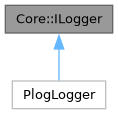
A logger class to be implemented around a separate logging library. ILogger is what will be used throughout the game files.
The public functions defined in the class are templates which use the format library to insert the extra parameters into the final string. To simplify operation for the backend, they receive the final formatted string in the log parameter, at which point they can log with it as is desired.
Member Enumeration Documentation
◆ Severity
|
strong |
Severity Enum - Middle man between each logging backed and their own severity terminology.
Constructor & Destructor Documentation
◆ ~ILogger()
|
virtualdefault |
Virtual destructor to ensure derived objects are guaranteed to have destructor
Member Function Documentation
◆ log()
|
protectedpure virtual |
Implementations only need to implement this log function to send logs to file, console, network, etc. This function is kept protected as for the majority of logs, the six severity functions should be sufficient for most logging purposes.
- Parameters
-
logLevel Log Severity message Formatted string to log
The documentation for this class was generated from the following file:
- /home/runner/work/etterna/etterna/src/Core/Services/ILogger.hpp
